


 One of the critical areas of intellectual property law is how to protect a brand when it is not registered. Unregistered trademarks play an important role in India’s trademark protection system. While registered trademarks receive statutory protection under the Trademarks Act, 1999, unregistered trademarks are protected under the common‑law remedy of passing off. Passing off prevents one party from misrepresenting their goods or services as those of another and protects the goodwill built by honest traders.
The central idea behind passing off is that goodwill is a commercial asset that deserves legal protection, even without registration. Although registration simplifies enforcement, Indian courts have consistently protected prior users, reinforcing the principle that use often prevails over registration.
Background and Context
A trademark is defined in the Trade Marks Act, 1999 under Section 2(1)(zb) as “a mark capable of being represented graphically and which is capable of distinguishing the goods or services of one person from those of others and may include the shape of goods, their packaging and combination of colours”. Registered trademarks enjoy statutory protection, while passing off protects unregistered marks through common law. The purpose is to prevent consumer confusion and protect business goodwill.
This common law doctrine was developed to prevent the deceptive use of marks and signs by one trader to misrepresent its goods or services as those of another trader, or vice versa. It is a remedy to protect unregistered marks from misrepresentation and is widely recognised in commonwealth countries such as the UK, the USA, Canada, New Zealand, and Australia.
Registered vs Unregistered Trademarks
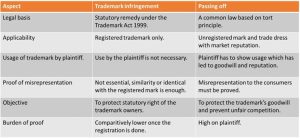
Registered marks can be enforced through infringement actions. Unregistered marks can be enforced only through passing off, where the plaintiff must prove use, goodwill, and deception. The difference between them is laid out in the table below-
Section 27(2)– “Nothing in this Act shall be deemed to affect rights of action against any person for passing off goods or services as the goods of another person or as services provided by another person“. This section protects unregistered marks under the law of passing off, even without any claim of statutory infringement. This preserves the right to sue for deceptive trade practices that cause confusion or damage to the goodwill of a business.
Section 11(3)– “A trademark shall not be registered if, or to the extent that, its use in India is liable to be prevented – by virtue of any law in particular, the law of passing off protecting an unregistered trade mark used in course of trade”. This provision is a useful tool to block competitors from registering similar marks. A mark may be refused registration if its use can be prevented under passing off.
Section 134- This section lays down the jurisdiction of instituting a suit before the District Court. It reads as follows:
“No suit-
- for the infringement of a registered trade mark; or
- relating to any right in a registered trade mark; or
- for passing off arising out of the use by the defendant of any trade mark which is identical with or deceptively similar to the plaintiff’s trade mark, whether registered or unregistered,
shall be instituted in any court inferior to a District Court having jurisdiction to try the suit.”
Section 135- This section provides civil remedies for the protection of unregistered marks by way of an injunction, damages or accounts of profits, or delivery up.
The Classic Trinity Test
There are three elements for constituting passing off, also known as the Classic Trinity Test. This formulation has been repeatedly adopted by Indian courts, including the Supreme Court in Cadila Health Care Ltd. v. Cadila Pharmaceuticals Ltd. (2001) 5 SCC 73, thereby establishing it as the settled legal position. The three elements are:
- Goodwill: The mark must have acquired distinctiveness and consumer recognition.
- Misrepresentation: The defendant’s use should deceive or be likely to deceive the public into believing the goods or services come from the plaintiff.
- Damage: There must be some loss of sales, diversion of customers, dilution, or harm to reputation.
The burden of proof in cases of passing off lies on the plaintiff, who must prove that the mark has acquired goodwill and has been damaged by misrepresentation. Courts are rigorous; they examine the public’s perception from the vantage of an average consumer with “imperfect recollection”.
Case Laws and Examples
In N.R. Dongre vs Whirlpool (1996) 5 SCC 714, the Supreme Court of India recognised that the trademark law does not grant an indefeasible right to the holder of a registered trademark. The Apex Court held that the ‘prior use’ and transborder reputation and goodwill of Whirlpool, even in the absence of any registration, was enough to cause damage by the plaintiff. The worldwide prior user was given preference over the registered trademark in India of the defendant.
In Milmet Oftho vs Allergan (2004) 12 SCC 624, the Supreme Court protected the first international user of the marks in dispute. The marks of the pharmaceutical preparation were similar, but the prior user worldwide had not registered its mark in India, whereas its adversary had. The Supreme Court approved the grant of an injunction in favour of the prior user.
- Syed Mohideen vs P. Sulochana Bai (2016) 2 SCC 683
The Supreme Court pithily underscored that the rights in a passing-off action emanate from the common law, not from statutory provisions; nevertheless, the prior user’s rights will override those of a subsequent user, even though the latter has been granted registration of its trade mark.
Neon Laboratories vs Medical Technologies (2016) 2 SCC 672
The court recognised ‘first in the market’ and ‘first user’ tests to hold that prior users’ rights will override those of a subsequent user, even though the subsequent user had been accorded registration of a trademark. The Court placed reliance on Section 34 and observed that the proprietor of a trademark does not have the right to prevent use by another party of an identical or similar mark where that user commenced before the user or before the date of registration of the proprietor, whichever is earlier.
Toyota Prius Case (2018) 2 SCC 1
This case shifted focus to territoriality; global reputation is insufficient without proof of recognition in India. Here, the mark ‘Prius’ was in conflict. The impugned mark was not registered by the Plaintiff but was registered by the defendant in 2002. The Court relied on the Territoriality Doctrine and referred to the Starbucks vs British Sky Broadcasting case and held that “No trader can complain of passing off as against him in any territory in which he has no customers, nobody who is in trade relation with him.”
Bolt Technology vs Ujoy Technology 2023 SCC OnLine Del 7565
The Delhi High Court, relying on the Toyota judgment, held that the plaintiff failed to establish “substantial goodwill” in the Indian market and was not granted protection. The court emphasised that foreign entities must demonstrate a substantial reputation in India.
Recent Developments
Territoriality strengthened: Recent decisions make clear that Indian courts do not protect a foreign brand simply because it is famous abroad. A claimant must show that it has goodwill in India by the relevant date. The Supreme Court’s decision in Toyota vs Prius established this territoriality principle, and lower courts have applied it strictly in subsequent cases.
Digital evidence has become important: Courts now increasingly accept digital metrics as evidence of reputation: website traffic, India‑based downloads/users, social‑media analytics, online advertising reach, and e‑commerce sales figures. However, judges require that the digital evidence be tied to Indian consumers. Mere global app downloads or generic worldwide web traffic without India‑specific indicators is usually insufficient. Recent case law, such as Bolt Technology vs Ujoy Technology, has placed reliance on such metrics while insisting on India‑specific proof.
Higher evidentiary burden for unregistered marks to show prior use: Judges now scrutinise passing‑off claims more closely. Plaintiffs with unregistered marks must produce concrete evidence of:
- first use
- continuous and bona fide commercial use
- efforts to promote the mark through ads, promotion, and trade fairs
- actual or likely consumer confusion.
While the evidentiary bar is higher at trial, courts remain prepared to grant interim injunctions in passing‑off suits where the plaintiff can show a prima facie case of reputation and likelihood of confusion, and where the balance of convenience favours preservation of goodwill.
Goodwill to be shown in mark and not only goods/services: In a recent case of VIP Industries Ltd vs Carlton Shoes Ltd. 2025 SCC OnLine Del 4620, the Court held that goodwill for a passing‑off claim must be shown in the mark itself, not restricted to the goods or class in which it was first used. A division bench upheld an injunction restraining the luggage‑maker from using the mark “CARLTON”, originally used by the plaintiff in footwear, observing that trademark protection covers the mark broadly, and goodwill may be “portable” across different product categories once properly established. The Court’s reasoning prevents “product‑specific goodwill” as a requirement; instead, it emphasises that goodwill once shown belongs to the mark as a whole.
Trade dress/product get‑up protection: In recent cases, such as Crocs Inc. USA vs Bata India 2025 SCC OnLine Del 4626, Indian courts are recognising that features such as packaging, shape, colour combinations, and overall trade dress can attract passing‑off protection even without registration, particularly where such elements have become distinctive of the Plaintiff’s goods in the relevant market.
Conclusion and Future Directions
Passing off is a sui generis common law remedy for protecting unregistered trademarks in India. While statutory registration under the Trade Marks Act, 1999, remains the most straightforward way to secure rights, Indian courts consistently safeguard the interests of honest prior users, recognising the goodwill they have built through uninterrupted and continuous use.
To strengthen protection and reduce enforcement risks, businesses must:
- Maintain comprehensive, continuous evidence of use, including dated invoices, advertisements, packaging records, and increasingly, India-specific digital evidence, such as analytics, online sales data, and targeted advertising records.
- Conduct regular trademark watch and market monitoring to oppose or challenge deceptively similar marks promptly.
- Build and strengthen digital presence, ensuring measurable engagement from Indian consumers, as courts now treat digital evidence as a key indicator of goodwill.
- Focus on establishing goodwill within the relevant Indian market, as transborder reputation alone is no longer sufficient to sustain a passing‑off claim.
- Apply for trademark registration at the earliest opportunity, both to ease enforcement and to avoid procedural hurdles associated with unregistered marks.
Passing off will continue to evolve with changing business practices, digital commerce, and judicial interpretations, but its core purpose of protecting goodwill and preventing consumer deception remains constant.
Author: Anju Agrawal
First Published by: Mondaq here